
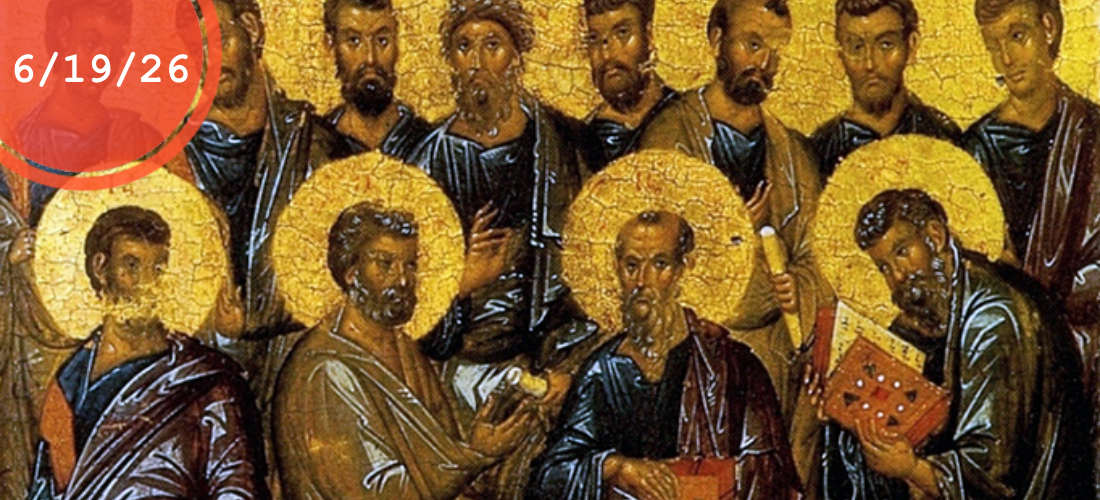
In Acts 15 we find an account of the very first (and most important) church council in Christian history, often dubbed the Jerusalem Council (A.D. 48-49). Leaders like Peter, Paul, Barnabas, Silas, James, and many others gathered to discuss one of the most pressing issues facing the early church—What do we do about Gentiles who wish to follow Israel’s Messiah?
Some believers argued that Gentiles must first become Jews. They must become circumcised, follow the Torah, and embrace Jewish dietary law. Only then can they belong to the covenant community.
Others disagreed. Peter gave testimony to his experience in Caesarea Maritima where he saw the Holy Spirit fall upon a Roman centurion, Cornelius, and his entire household and baptized them on the spot as Gentiles. Paul and Barnabas also gave accounts of God’s work among Gentiles during their missionary journeys.
After much discussion and debate, the gathered leaders came to a unanimous agreement. Gentiles are to be welcomed into the Jewish body of Messiah just as they are, provided they abstain from four things: (1) Food associated with idolatry (my emphasis), (2) Sexual immorality (porneia) (3) What has been strangled, and (4) Blood (Acts 15:20).
Several years later (around A.D. 53–55), Paul wrote his first letter to the gathered church in Corinth. On the issue of meat sacrificed to idols, Paul never mentions the decision of the Council. Instead, he gives a much more nuanced set of instructions. While firmly prohibiting idolatry and pagan worship, Paul’s instructions regarding consuming meat sacrificed to idols can be summarized as follows:
(1) Meat itself is morally neutral.
(2) Because idols are not real gods, Christians are free to eat meat regardless of its prior association with pagan sacrifices.
(3) However, Christians must never participate in pagan worship, and…
(4) they should willingly refrain from eating when doing so would harm another believer’s conscience or communicate participation in idolatry (1 Cor. 8-10).
In other words, Paul preserves the council’s underlying concern about idolatry while applying it differently in the context of Corinth. The result is a noticeable tension between the straightforward prohibition of Acts 15 and the more situational guidance found in 1 Corinthians 8–10.
A few decades later, a prophet named John receives a series of visions while exiled on the island of Patmos. Among those visions are seven messages addressed to churches in Asia Minor (Revelation 2–3), each presented as a message from the risen Jesus Christ.
In these letters, the practice of consuming meat sacrificed to idols is categorically forbidden and regarded as serious sin. The churches in Pergamum and Thyatira are sharply rebuked because some among them have embraced teachings that encourage believers to eat food sacrificed to idols and participate in practices associated with pagan worship. For John, such behavior represents compromise with the surrounding culture and is incompatible with faithful allegiance to Christ.
Notice the differing perspectives here. The Jerusalem Council prohibits food associated with idols. Decades later, John appears to reaffirm that prohibition without qualification. Paul, however, makes a distinction between participation in idol worship and the mere consumption of meat that had previously been offered in sacrifice, which he permits under certain circumstances.
So the New Testament does not speak with a single voice on this issue. Rather, we find different authors addressing the same question in different ways, shaped by the pastoral challenges and circumstances facing their communities.
This suggests that we should be cautious about treating Acts and the New Testament epistles as a comprehensive law code containing universally applicable rulings for every situation. Rather, they are inspired accounts of apostles, pastors, and congregations using wisdom to discern what faithfulness to Jesus looked like in their specific contexts.
To be sure, beneath these writings lies a shared theological foundation centered on allegiance to Christ and his vision. Yet the application of those convictions is often contextual rather than uniform.
I’m using this example as a case study with hopes of helping us better understand what the Bible is for and how it works. If early Christian leaders and churches differed on how they sought to embody faithfulness to Christ, and these differences are inscribed within the Bible itself, then what does that reveal to us about the Bible’s purpose? Rather than constantly detaching independent verses and citing them like an attorney holding a law journal, perhaps the Bible is instead inviting us to seek and apply Spirit-inspired and Jesus-centered wisdom for our own particular contexts?
For example, I’m convinced that a similar dynamic is happening within the New Testament as it pertains to the topic of women teaching in churches.1 Of course, this is a hot-button issue at the moment due to the recent meetings in Orlando within the Southern Baptist Convention. I won’t comment on those matters, except to say, while I continue to disagree with my complementarian brothers and sisters within the SBC, I refuse to publicly assume their motives, and I respect their right to follow their own conscience and wrestle with this issue within their own local communities.
Nevertheless, I cannot help but suggest that faithfulness to Jesus on this issue is often kaleidoscopic rather than uniform. For the writer of 1 Timothy (who I contend was not actually Paul) and the letter’s recipient, it was determined, “I do not permit a woman to teach or to have authority over a man; she is to keep silent” (1 Tim. 2:12). Okay, “Paul.” I accept that there were concerns within your own time and place that led you to this conclusion.2
And yet, we do have numerous recorded examples within the New Testament of women involved in apostolic ministry, prophetic ministry, theological instruction, missionary work, house-church leadership, diaconal ministry, and gospel partnership alongside male leaders.3
Perhaps this is one of the Bible’s greatest gifts. Rather than offering a comprehensive catalog of answers for every conceivable circumstance, it invites us into the same Spirit-led process of discernment practiced by the earliest followers of Jesus. The New Testament records their attempts to work out what allegiance to Jesus looked like in a variety of circumstances. And sometimes they arrived at different applications while remaining rooted in the same gospel.
The goal of biblical interpretation is not merely to locate a rule and apply it mechanically. It is to immerse ourselves in the story of Jesus, attend carefully to the witness of Scripture and interpretive tradition, and remain open to the dynamic leading of the Holy Spirit, seeking to discern together what faithfulness looks like here and now. That task is more demanding than proof-texting.
The question is not merely, “Which verse settles the matter?” but rather, “How can we faithfully embody the way of Jesus here and now?” The early church had to wrestle with that question in its own time. We still do today.
- For a thorough explanation of my own position, read here. ↩︎
- For those who contend that the instruction regarding women in 1 Timothy 2 is universally binding because of the author’s point about Eve being deceived and transgressing and not Adam (vv. 13-14), first I point back to the issue of eating meat sacrificed to the idols. While Paul permits the practice (under certain circumstances), the categorical prohibition against eating such meat in Revelation was purportedly given by Christ himself in a vision(!) Furthermore, was Adam not also deceived and guilty of transgression? If not, how so? We should at least acknowledge the difficulty Christian interpreters have had with this section of 1 Timothy 2 throughout history. ↩︎
- Acts 21:8–9; 1 Corinthians 11:5; Acts 18:24–26; Romans 16:1–2; Romans 16:7; Romans 16:3–5; Acts 18; Colossians 4:15; Acts 16:14–15, 40) ↩︎

