A bit earlier today on Threads, someone posed the following question:
The text doesn’t really give us much reason to think the “Hosanna!” crowd and the “Crucify him!” crowd were the same people, right?
It’s an interesting question. I’m not sure how much, if anything, is at stake here. But I’ve often heard the statement, “The same crowd that chanted ‘Hosanna!’ on Palm Sunday was chanting ‘Crucify him!’ on Good Friday.” It preaches well.
But is it true? To be honest, I can’t say for sure. But I seriously doubt it.
First, the Palm Sunday crowd seemed to be made up mostly of Passover pilgrims who had been traveling with Jesus from Galilee and from other places who joined along the way. Note the example of Bartimaeus, who after being healed, “followed him on the way” (Mk. 10:52). Also, notice how Matthew contrasts the Palm Sunday crowd with the inhabitants of Jerusalem:
When he entered Jerusalem, the whole city was in turmoil, asking, “Who is this?” (Mt. 21:10).
The city of Jerusalem, which normally maintained a population of around 20,000-30,000 people, during Passover season would swell up to about 2 million pilgrims from around the world. That’s a whole lot of people. So the multitudes who gathered in Jerusalem that week were not a monolith. And on that basis alone, it’s a significant leap to conflate the Palm Sunday crowd with the Good Friday crowd. It would be like me shopping at Target one afternoon, then returning a few days later, and assuming that the crowd of shoppers on both days was identical.
Secondly, all throughout the week, the Temple establishment had been plotting to arrest Jesus and kill him. But they realized that they had to do so by stealth. They were concerned a public arrest would cause a riot (Mt. 26:3-5). All the way up to Good Friday, Jesus remained a hugely popular figure with his followers.
This is the whole reason why the Temple hierarchy was willing to pay Judas. The arrest needed to take place in secret, under cover of darkness, away from the public eye. Judas knew Jesus’ movements. He knew he could find Jesus in the privacy of Gethsemane in the evening. From there, Jesus would be led straight across the Kidron Valley to the home of Caiaphas where he would undergo a sham, overnight trial.
Then very early in the morning, Jesus is handed over to Pilate, who at some point presents a gathered crowd with the choice of releasing either Jesus, or a violent revolutionary named Barabbas. Here’s how John describes it:
After he had said this, he went out to the Jews again and told them, “I find no case against him. 39 But you have a custom that I release someone for you at the Passover. Do you want me to release for you the King of the Jews?” 40 They shouted in reply, “Not this man but Barabbas!” Now Barabbas was a rebel. (Jn 18:38-40)
Numerous times throughout John’s account of Passion Week, he uses the phrase “the Jews.” This is a quite unfortunate reality that has been used to promote and support abhorrent antisemitism throughout history. Nevertheless, whenever we see this phrase in the Gospel of John, he’s using this phrase as shorthand to refer to the Jewish leadership in Jerusalem who stood in opposition to Jesus. Not to Jews in general. Again, John’s use of this phrase has had terrible ramifications throughout history. And I think translators need to come up with other options.
Regardless, it tells us something about the composition of this crowd. Keep in mind that the whole point of staging a secret arrest followed by an overnight “trial,” along with handing Jesus over to Pilate in the wee hours in the morning was to get him convicted and sentenced before the public could assemble and influence anything.
If everyone in Jerusalem (all 2+ million!) had turned on him by that point, then there would be no need for any of that nonsense. But that’s not the case.
So, I don’t think there’s any reason to think they were the same crowd, and plenty of reason to assume they weren’t. It doesn’t preach as well, but I think it’s probably the truth.
Nevertheless. Have a meaningful Holy Week. Don’t rush to Easter. Embrace the story.
“Look, the young woman is with child and shall bear a son and shall name him Immanuel.” —Isaiah ben Amoz, 734 BCE (Isa. 7:14)
For nearly twenty centuries, Christians have drawn upon Isaiah’s Immanuel oracle as a prophetic connection in support of the doctrine of Christ’s divinity. Indeed, the Gospel of Matthew references this ancient prophecy in his account of the birth of Jesus:
“All this took place to fulfill what had been spoken by the Lord through the prophet: ‘Look, the virgin shall become pregnant and give birth to a son, and they shall name him Immanuel,’ which means, ‘God is with us’” Mt. 1:22-23 (NRSV).
Following this tradition, every year during Christmas season, Christian churches gather together to sing, pray, and reflect upon Jesus as Immanuel. However, in order to better engage with this ancient text and to avoid common misconceptions, it would be helpful for us to explore its original context and learn more about its interpretive history.
Historical Background of the Events of Isaiah 7
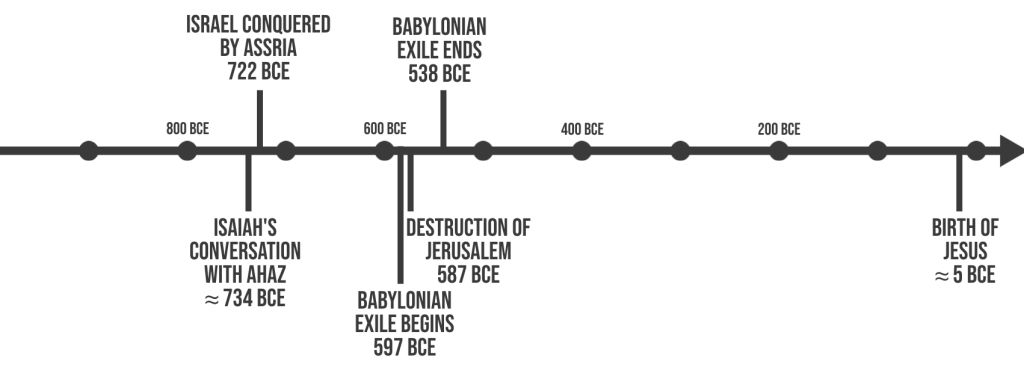
Sorry for the poor image quality!
The occasion for this famous encounter between Isaiah son of Amoz with King Ahaz of Judah is at the beginning of the Syro-Ephraimite War (likely 734 BCE). The Assyrian Empire, under Tiglath-Pileser III, is expanding westward, seeming to impose a serious threat to the nations of Syria, Israel, and Judah. Therefore, Rezin, the king of Syria, and Pekah, the king of Israel form a military alliance to withstand any potential Assyrian advance on the region. Seeking to bolster their strength, the joint forces of Israel and Syria plan to besiege Jerusalem and attempt to dethrone Ahaz, installing a puppet king to ensure Judah’s participation in the coalition.[1]
It is immediately before this siege that the conversation depicted in Isaiah 7 between the prophet and the king occurs. Ahaz has been exploring the possibility of reaching out to Assyria to protect Judah from its neighbors to the north in return for paying tribute. Isaiah prophetically challenges Ahaz to resist this urge and to instead put his trust in YHWH, using a small child as a prophetic oracle to communicate the Lord’s impending deliverance. However, as Hyun Chul Paul Kim states, in the end “King Ahaz could not make a leap of faith relying on the prophecy of a little child but instead resorted to submitting to the grown-up Assyrian king Tiglath-pileser III.”[2]
Overview of Isaiah 7:1-9
The passage begins with a brief reference to the siege of Jerusalem and Ahaz’s fearful reaction (vv. 1-2). The Lord instructs Isaiah to take his son and meet Ahaz “at the end of the conduit of the upper pool” (v. 3), where Ahaz is likely inspecting the city’s water supply in preparation for the siege.
Isaiah’s prophetic message to Ahaz begins with the exhortation, “Do not fear” (v. 4). Ahaz is assured that the threat from Rezin and Pekah will come to nothing, because they are mere men who are no match for YHWH (vv. 4-9a). However, this promise is conditioned upon Ahaz putting his trust in YHWH rather than in an alliance with Assyria.
Unfortunately, Ahaz will eventually choose the pragmatic option of seeking Assyria’s help. This policy was problematic not simply because of its idolatrous nature, but also because of the resulting burden it would inevitably extend to the ordinary people of Judah. As a result of its alliance with Assyria, Judah would now pay tribute to the empire, which would result in a substantial increase in taxation. While this move would save his political power, it would result in economic hardship for the rest of the population.
The Immanuel Prophecy: Isaiah 7:10-17
Through Isaiah, the Lord now invites Ahaz to ask for a sign, an invitation that is unprecedented in the Bible. Ahaz refuses to ask for a sign, pretending to take the pious approach. In verse 13, Isaiah responds by giving voice to YHWH’s frustration (“Is it too little for you to weary mortals that you weary my God also?”). It seems as though Ahaz’s rejection of a sign betrays his predisposition for an alliance with Assyria.
In the narrative connected to this passage (2 Kings 16), Ahaz’s eventual plea to Tiglath-Pileser III begins with the statement, “I am your servant and your son” (v. 7, emphasis mine). Here, Kim sees a possible source of YHWH’s frustration: “In an intertextual reversal of Psalm 2, where YHWH declares to the Davidic king, ‘you are my son’ (Ps 2:7), Ahaz now renounces this sonship and becomes Assyria’s slave and son.”[3]
Therefore, given Ahaz’s refusal, the Lord gives him a sign: “Look, the young woman is with child and shall bear a son and shall name him Immanuel” (v. 14b). The Hebrew word for young woman, is ‘almā, which, according to John J. Collins, “can, but does not necessarily, refer to a virgin.”[4] Walter Brueggemann notes that the word simply refers to “a woman of marriageable age.”[5]
There seems to be no suggestion whatsoever that this verse is speaking of a miraculous conception. Among scholars, there are many theories floating around pertaining to the identity of this young woman. I am inclined to agree with the prevailing assumption that whoever she is, she is most likely closely associated with Ahaz, perhaps his wife or a woman in his harem.[6] Regardless, she must be an identifiable figure in order for the sign to have any meaning to Ahaz. The son shall be named Immanuel, meaning “God is with us,” which for Ahaz is meant to serve as a summons to faith, trusting that the Lord will protect and defend Judah.
In vv. 15-16, Isaiah declares, “He shall eat curds and honey by the time he knows how to refuse the evil and choose the good. For before the child knows how to refuse the evil and choose the good, the land before whose two kings you are in dread will be deserted.” In other words, the oracle seems to indicate that within a very short time following the child’s birth, the threat will be removed, Judah will live in peace and prosperity, and its northern neighbors will have serious problems of their own.
Finally, verse 17 declares, “The Lord will bring on you and on your people and on your ancestral house such days as have not come since the day that Ephraim departed from Judah—the king of Assyria.” In its immediate context, YHWH turns His attention away from Ahaz and issues a declaration of judgment directly towards Syria and Israel (Ephraim). Indeed, the Assyrians will completely decimate these regions within a short period of time. However, it seems there also might be something else going on. Could this verse possibly be a double-edged sword, addressing multiple audiences living in different time periods?
The Immanuel Prophecy for the Exilic Community
In light of Ahaz’s ultimate refusal to trust in YHWH, verse 17 could also be seen as an intentional harbinger of what will come much later for the nation of Judah at the hands of Nebuchadnezzar in the early 6th Century when Jerusalem is destroyed and many Jews are exiled to Babylon.
The scholarly consensus is that book of Isaiah is an anthology of prophecies and narratives that originated from at least three different sources who lived over a span of at least 200 years. In the ensuing generations, scribes edited and assembled these works into what we now know as the Book of Isaiah.
For reasons I won’t enumerate here, it seems likely that the composers and redactors of this particular passage were shaping this story (set during a much earlier time) in order to speak freshly into the experience of the exilic community following the catastrophe of 587 BCE, challenging them to live in fidelity to YHWH, the true Lord of history.
Immanuel in Christian Interpretation
At some point between the 3rd and 1st centuries BCE, the Hebrew text of Isaiah 7 would be translated into Greek and become part of what we now call the “Septuagint” (the Greek translation of the Hebrew canon). The Hebrew word, ‘almā, translated “young woman” in verse 14, becomes parthenos in Greek, commonly translated “virgin.” It is this Greek version of Isaiah 7:14 that will later be cited in Matthew 1:23 in connection to the virgin birth of Christ.
Interestingly, it’s been demonstrated that at the time of its translation, parthenos “did not necessarily refer exclusively to a virgin (though of course it often included that meaning when appropriate), but that it developed to have that sense in a narrower way in the immediately pre-Christian decades.”[7] Thus, linguistic development paved the way for new theological development.
It must be acknowledged that this interpretive innovation on the part of Christians was certainly not anchored to the original intent of Isaiah’s prophecy as found in the text. However, as demonstrated above, the capacity for the prophecy to morph and speak freshly and legitimately into new contexts is embedded into the history and origin of the biblical passage itself. Therefore, as Wegner asserts, Isaiah 7:14 “forms a ‘prophetic pattern’ which Matthew picks up…and fills it with more meaning by applying it to Jesus.”[8]
Concluding Reflections
For Christian interpreters of the Bible, I would like to offer a few thoughts. First, it is necessary that we adopt a humble and open posture in our task of interpreting texts like these. For many centuries, Isaiah 7 has been a battleground between Jewish and Christian interpreters. However, when one learns about the context and history of this beautiful passage, it should be apparent that there is no need to stake an exclusive claim for one interpretation over another. Indeed, the original formation of this text itself is a creative, Spirit-inspired prophetic word for a contemporary audience far removed from the events depicted (much like the musical Hamilton or the 2012 film Lincoln).
Secondly, years ago in my “Hermeneutics” class in Bible College our curriculum instructed us to always use the “historical-critical” method of bible interpretation. The historical-critical method begins with the premise that the meaning of any passage is always located within the author’s intent. Therefore, it stresses the value of using tools to uncover the historical, cultural, and linguistic contexts when engaging in Bible study.
No doubt, embracing the role of context and identifying the author’s intent is always essential in the process of interpretation. However, the assumption that the text’s meaning is always governed by the author’s intent is not only false, but problematic (as this case study hopefully demonstrates). If Christians stubbornly hold to this assumption, we are sawing off the very plank we stand on.
The original authors and redactors of the Book of Isaiah had absolutely no idea that this passage from Isaiah 7 would later spark an entirely new connection that would have nothing to do with King Ahaz or the exilic community. The early Christian community’s association of the Immanuel prophecy with the virgin birth of Christ was a theological innovation aided by new translation and linguistic development that occurred long after the events depicted in Isaiah 7 or the text’s composition.
While the historical-critical method is an invaluable approach to discerning what a passage means in its original setting, it must be recognized that elucidating “meaning” from a text is not a lab science, but an ongoing Spirit-inspired process that often leads in unanticipated directions. This isn’t to say that “meaning” is up-for-grabs for anyone to twist as one likes. Interpretation always belongs within the broader Christian community (guided by the illumination of the Spirit).
However, over and over again, the Bible itself authorizes the creative, Spirit-inspired repurposing of prophetic texts to speak freshly into new contexts. Brueggemann calls this the “generative” capacity of prophecy. Once we embrace this idea, we can not only stand firm on the historical Christian connection of Immanuel with the virgin birth of Christ, but we can also keep our eyes open, looking for new ways in which we are indeed being invited to trust in God and uniquely experience God with us in our own contexts and experiences.
[1] These events are recounted in detail in 2 Kings 16ff and 2 Chron. 28:5ff.
[2] Hyun Chul Paul Kim, Reading Isaiah: A Literary and Theological Commentary (Macon, GA: Smyth & Helwys, 2016), 8.
[4] John J. Collins, A Short Introduction to the Hebrew Bible, 3rd ed. (Minneapolis, MN: Fortress Press, 2018), 218.
[5] Walter Brueggemann, Isaiah 1-39 (Louisville, KY: Westminster John Knox Press, 1998), 70.
[6] For a detailed discussion regarding the woman’s identity, see H. G. M. Williamson, Isaiah 6-12 (New York, NY: Bloomsbury T&T Clark, 2018), 155-160.
[7] H. G. M. Williamson, Isaiah 6-12 (New York, NY: Bloomsbury T&T Clark, 2018), 155-160.
[8] Paul Wegner, Isaiah: An Introduction and Commentary (Downers Grove, IL: InterVarsity Press, 2021), 96-97.
Without a doubt, the hottest streaming series this Spring is Apple TV’s psychological thriller Severance, created by Dan Erickson and directed by Ben Stiller. Severance currently boasts a 96% rating on Rotten Tomatoes, and since its premiere on January 17, Season 2 alone has garnered a viewership of over 3 billion streaming minutes. In other words, Severance is a bonafide, all-time hit.
Hamony Cobel (Patricia Arquette) is the bizarre Supervisor of the severed floor in Season 1.
The story revolves around protagonist Mark Scout (played by Adam Scott) who is employed by a local branch of a mysterious global corporation, Lumon Industries. One particular floor of Lumon’s massive office complex is devoted to work so secretive that incoming employees are required to undergo a controversial surgical procedure. The surgery implants a chip into the brain that separates employees’ “work memories” from the rest of their memories.
The effect is that each severed employee (or “innie”) has a life that is carefully curated and dominated by Lumon, with no cognitive connection to one’s life in the outside world. Likewise, the same person outside of the office (or the “outie”) has no recollection of anything that happens at work.
For its severed workers, Lumon has created an entire world of peculiar nomenclature, imagery, customs, routines, and company history to tame its employees’ curiosity and satisfy their longing for meaning. By doing so, Lumon is able to manipulate and control their entire lives.
But as the story progresses, Mark and some of his co-workers intuitively suspect that something is amiss with Lumon and the existence that has been crafted for them. They become increasingly disenchanted with their experience and begin to imagine what life is like beyond their home on the windowless severed floor.
Creepy statue of Lumon CEO, Jame Eagan (Michael Siberry)
Something similar is happening right now inside the world of American Christianity. Many of us have been handed a severed gospel, largely stripped of what makes the Jesus story so rich, beautiful, and intoxicating.
The gospel is the story of God setting right a world gone wrong. It’s a story that begins with God choosing Abraham and forming his descendants into a great nation through whom God will bless the entire earth. The story continues with the promise that God will establish as king one of David’s descendants who will reign eternally and whose kingdom will encompass the entire earth.
Finally, the story culminates with Jesus of Nazareth, Israel’s messiah, winning an atoning victory on the cross, and being raised and ascended to the Father’s right hand, where he is now enthroned as king of the nations.
Therefore, in response to this good news, the invitation of the gospel is to come under the reign of King Jesus and join the community of believers who (by God’s grace) are together learning to embrace and embody his vision for life as God intends it to be lived. A life that continues on in the age to come.
It is the life Jesus taught and modeled for us. A life characterized by the Sermon on the Mount. A life marked by peace-making, enemy love, patience, and self-denial. And it is through these kinds of cross-shaped communities that God is mending, healing, and saving a lost and broken world.
Yet for many of us, the gospel we’ve inherited sounds quite different. Rather than a story that includes what God is up to in the world right now through the reign of King Jesus, the gospel has been presented to us as a formula for individual salvation regarding how to get to heaven when we die. It’s mechanical. Formulaic. Transactional.
It’s not that this gospel is wrong, per se. It’s just incomplete. It’s a severed gospel. This severance didn’t happen overnight but gradually morphed over several centuries.
It is difficult to locate a definitive starting point, but certainly the Protestant Reformers were instrumental in its development and circulation. John Calvin, in particular, was a trained lawyer who later became a prominent theologian. Calvin’s theological work on soteriology was significantly shaped by his legal background and would become hugely influential in affecting how future generations in the West would understand the gospel.
John Calvin (1509-1564)
Consequently, people began to view salvation primarily through a legal framework—that guilty sinners can be “acquitted” because of Jesus’ atoning death on the cross and thereby receive forgiveness and salvation.
Indeed, this is true so far as it goes. And certainly the apostle Paul, in his writings, frequently employs legal metaphors. But it isn’t nearly enough to delineate the full scope and nature of salvation and the gospel as described in the story the Bible tells.
The severance process continued throughout the era of colonialism and the transatlantic slave trade. As Western empires sought to conquer and control foreign lands and peoples, the Christian enterprise was often a complicit partner.
As territories were being occupied and exploited, many Christian missionaries and pastors focused their work exclusively on “saving souls.” Colonizers and slaveowners sought to depict conquered and enslaved peoples as something less than human in order to excuse themselves from the ethical demands of Christ’s teaching, allowing them to perpetuate their oppression and exploitation.
Eventually, the American Protestant world would rupture with the Modernist-Fundamentalist controversy in the late 19th and early 20th centuries. A whole host of complicated issues was involved, but at the center of it was a fierce debate over the nature of the gospel.
During the Jim Crow era, many pastors and churches of all kinds were calling attention to the issues of poverty, inequality, and exploitation of workers. Drawing from the Bible, and in particular the teachings of Christ, they contended for a more just and equitable society.
However, some of these Christian leaders and institutions were also departing from orthodox Christian doctrines (such as the virgin birth and the bodily resurrection of Christ). It is also true that in some cases, the emphasis on Christ and the role of Christian worship were becoming deemphasized and displaced altogether.
This movement ignited a strong response from what would become the Fundamentalist movement, which aimed to counteract what was identified as a wholesale departure from normative, orthodox Christianity.
Along with reasserting the creedal foundational doctrines that some Modernists were rejecting, the Fundamentalists sought to declare once and for all a clear exposition of the gospel, centered upon a sin-forgiveness transaction based on Christ’s atoning death that results in the free gift of salvation. This is the gospel, the Fundamentalists would declare.
And thus, the fault lines were created. And they continue to rumble up to the present day.
This is the severed gospel we have inherited. And like Mark Scout and his co-workers on the severed floor, many Christians in America are longing for something more compelling. Dissatisfied with the simplistic script we’ve been handed, we crave to be part of a more beautiful story. A richer, grander metanarrative.
We yearn for a reintegration. Christ’s atoning death, his bodily resurrection, the experience of forgiveness for sin, and the promise of life in the age to come are indispensable components to this story. However, this is also a story that includes God’s longing for the world as it exists right now.
If we truly believe that Jesus is the reigning king of the nations today, then this gospel is not just something to be believed, but as the New Testament states repeatedly, it is to be obeyed.
Thus, the invitation of this good news is not simply to engage in a transaction to secure afterlife salvation, but to enter into and participate in Jesus’ saving, healing work in the world right now.