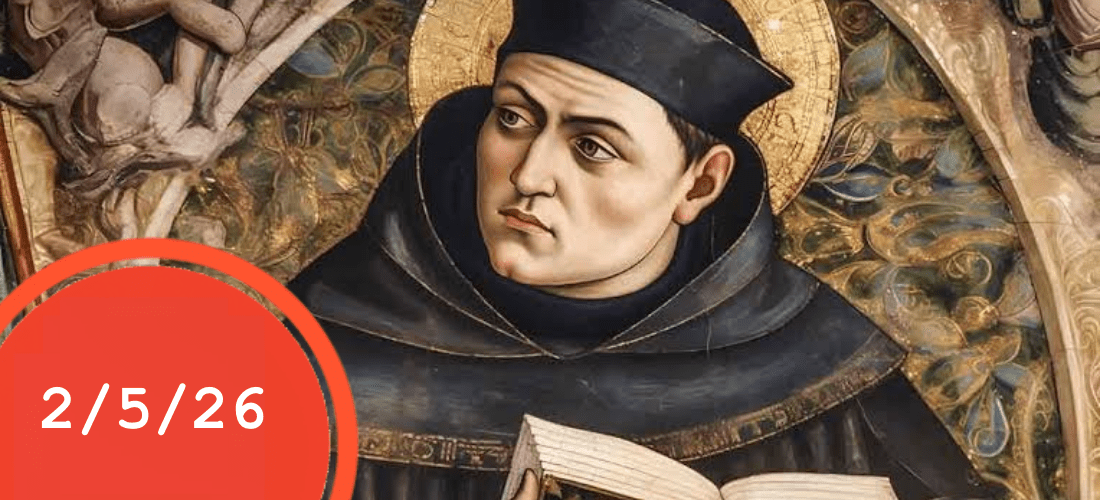
Near the top of the list of the most influential Christian theologians in history is Thomas Aquinas. His writings form the cornerstone of Roman Catholic theology and have exerted a lasting impact not only on Christian thought but also on the fields of ethics, metaphysics, and natural law.
In his Summa Theologica—which he never completed—Aquinas created one of the most far-reaching theological works in history. He harmonized divine revelation and human reason through Scripture, tradition, and Aristotelian thought, articulating a comprehensive vision of Christian doctrine.
Simply put, the magnitude of Aquinas’ theological legacy is often regarded as second only to Augustine of Hippo in the history of Western Christianity.
But in the final year of his life, around the age of 48, Aquinas was rocked by an extraordinary, life-altering experience. On December 6, 1273, Thomas attended Mass, as he did every day. But during the eucharistic service he was seized by an unexpected mystical encounter so powerful that he could neither describe it nor resume his scholarly pursuits. We do not know the precise content of Aquinas’s experience. Sources describe it as a vision or revelation during Mass, but Aquinas himself never detailed it.
But from that day forward, he stopped teaching.
He stopped writing.
His great tome, Summa Theologica, would go unfinished.
People close to Thomas immediately noticed a profound change. They were concerned about him. His dear friend and confidante, Reginald of Piperno, asked him, “Father, how can you want to stop such a great work?” Thomas merely replied that he could no longer continue writing. Reginald assumed that perhaps he was physically or mentally exhausted. He probed further. Again, Thomas replied, “Reginald, I can write no more.” But then he explained, “All that I have hitherto written seems to me nothing but straw.”
Thomas withdrew into silence. Later, during a visit to his sister, the difference in him was unmistakable. Turning to Reginald, she anxiously asked what had shaken her beloved brother so deeply.
This time Thomas elaborated further, “All that I have written seems to me nothing but straw . . . compared to what I have seen and what has been revealed to me.”
A short while later, on March 7, 1274, Thomas Aquinas would pass away.
Lately, I’ve been thinking a lot about this anecdote from Aquinas’ life. No matter how profound our scholarship, the divine cannot be fully captured in words. Yes, we cannot help but theologize. As incomprehensible as God is, we must find ways to conceptualize thoughts and articulate ideas if we are to enter into this relationship. Therefore, theology is not only necessary; it is unavoidable for those who wish to engage with God. So we do our best.
But let us not kid ourselves. Much of what we claim to know, we know only in part. We construct our systems, our doctrines, our statements of faith—and we must. Yet no matter how true those statements may be (and there is no record of Aquinas repudiating his earlier work), they remain words spoken about the Source of all that is, seen and unseen. The ever-expanding universe itself bears witness to this truth: God is immeasurably vast, and our belief statements are, by comparison, astonishingly puny.
Over the last few centuries, discoveries in cosmology, geology, biology, and other disciplines have burst old theological wineskins. And ready or not, there will likely be more Copernican-like revolutions in the centuries to come.
But among the theologically-minded, the wise and humble are open and flexible. They stand upon our creedal foundations while speaking slowly and thoughtfully about the divine mysteries.
Those who speak of sacred truths with flippancy, as if all were self-evident and trivial, profane what is most holy. Glib, unreflective certitude desecrates the sacred.
Some of the most spiritually hollow words appear in formulaic discipleship curricula, shallow worship songs, or the pages of popular Christian bestsellers. If Thomas Aquinas looked back upon his prior work as nothing but straw, I’m not sure what language could adequately describe these (actually I am, but I’d rather keep this piece PG-rated).
When we truly encounter the God who is ultimate transcendence, like Thomas Aquinas we cannot help but lay our ink pens down (or put our phones away), and to be still and behold. And we’ll know we are on the right track when our thinking and our conversation are infused with plenty of wonder, mystery, and awe—an awakening that comes from what we most need: profound encounters with Christ that leave us mystified.
 Ryan Post